The FINNS Search and Rescue helicopter has done it again! On May 26, 2026, the helicopter and its team completed a medical evacuation on Mount Rinjani in Lombok. A Malaysian tourist was rescued in very challenging circumstances that included severe weather conditions.
This operation, which was carried out and coordinated in conjunction with BASARNAS, SGI and Nusa Medica, helps to demonstrate the valuable and vital role played by privately-funded emergency response infrastructure in Indonesia.
The country faces specific and unusual difficulties in this respect because it is not a single contiguous landmass, but rather almost 18,000 islands scattered across a huge geographical area. When something is considered to be “hard to access” in Indonesia, it’s often because of a lack of roads, paths, and local transportation infrastructure.
This leaves services like the FINNS Search and Rescue Helicopter as the only viable means to reach people in trouble in these areas.
The Most Recent Mission: A Tourist In Distress
This mission involved a female tourist from Malaysia who had been climbing Mount Rinjani on Lombok Island. This is one of Indonesia’s tallest mountains, and it’s a tough climb even for experienced mountaineers.
The tourist fell on the slopes of Rinjani while she was descending from the summit and sustained serious injuries, making it impossible to move her any distance. Following her accident, her fellow hikers managed to move her to a temporary tented area where she could take shelter while awaiting evacuation.
She was reporting severe and significant back pain alongside other trauma-related injuries from the fall.
The Call For Help And Weather Frustrations
SGI was contacted by the team at Nusa Medica at 15.13 on the 25th of May, asking for help with this emergency.
The flight team sprang immediately into action, conducting operation preparation exercises, maintenance clearance, weather assessment and flight plans.
At 16.16 the same day, the FINNS Search and Rescue Helicopter left Bali heading to Lombok to rescue the injured tourist.
At 17.05, the crew arrived on Mount Rinjani with visibility of the patient’s location. However, the conditions for a rescue were lost immediately as dense fog rolled over the mountain, meaning that visibility was too poor for a safe extraction.
The flight crew did not give up, and instead, they went through a series of holding patterns to assess the conditions and see if they could find a window to safely attempt the rescue.
Sadly, despite all their efforts, visibility continued to worsen. Indonesian aviation regulations require all helicopter operations across the archipelago to finish at sunset, and that meant as the day drew to a close, the crew was forced to abort the operation and return to base.
At 18.02, the FINNS Search and Rescue Helicopter touched back down in Bali. The crew had to wait overnight for first light before they could resume their efforts.
The Rescue – A Big Success For FINNS Search And Rescue Helicopter
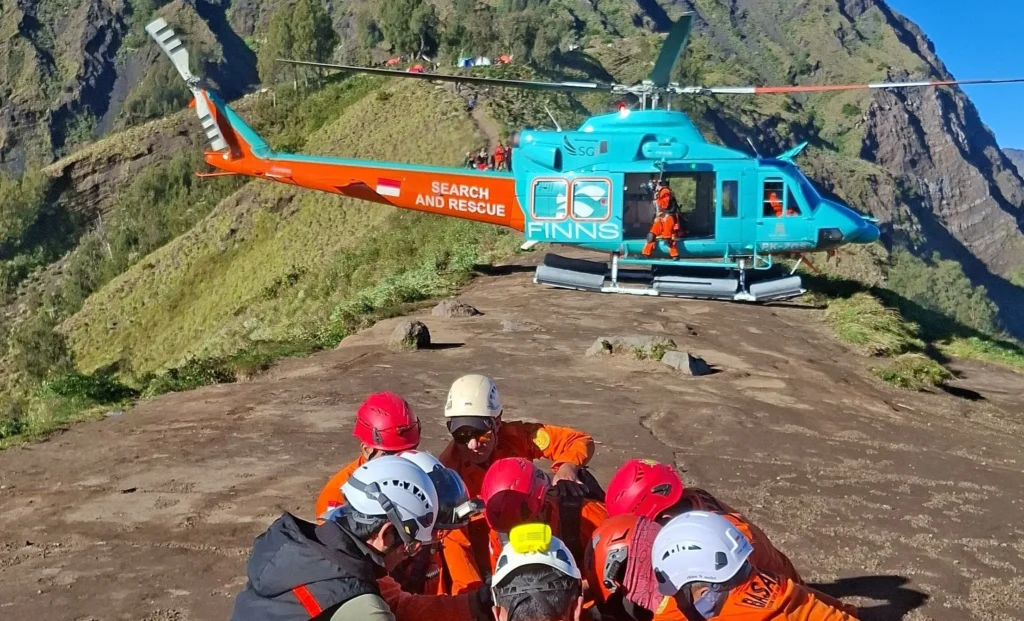
Fortunately, the next morning, weather conditions on the mountain were reported as much improved and at 7.05, the helicopter took off from Bali, and it reached the tourist’s site at around 8.10.
The highly trained operations team on the helicopter conducted an aerial assessment of the area and concluded it was now safe to launch a rescue. There was a landing zone available for direct helicopter access, and the aircraft touched down there at 8.13.
The crew immediately attended to the injured woman, who was conscious but wasn’t able to move independently. The team used a stretcher to secure the traveller and then evacuated the mountain a short time later at 8.16.
They returned immediately to Bali and touched down at the SGI Heliport at 9.04, and the patient was transferred into a waiting Nusa Medica ambulance, where she could receive immediate treatment.
The Reactions
Paul Hussey, the Chief Operating Officer of FINNS, was one of the first to celebrate the landing, and he said, “Operations like this are exactly why the FINNS Search & Rescue Helicopter exists.”
“When somebody is injured in a remote or mountainous area, time matters. These environments are incredibly challenging, and weather conditions can change within minutes.
“SGI ensure our crews are trained to make difficult operational decisions in real time, always prioritising safety while doing everything possible to reach those in need.
“This rescue highlights the importance of having a rapid-response capability that can assist where traditional access routes may take many hours.”
SGI Air Bali’s CEO, Paul Doxey, wanted the world to know that this successful evacuation was the result of strong coordinated efforts between all the operation partners involved in the mission.
He said, “This mission required patience, precision and teamwork.”
“The weather conditions on day one made rescue operations unsafe, but the crew remained prepared and resumed the mission immediately once conditions improved.
“We are proud to work alongside BASARNAS, Nusa Medica and FINNS Search & Rescue to help deliver critical emergency response support across Indonesia.”
Final Thoughts On This Successful Mission
This mission, once again, demonstrates the powerful ability of the FINNS Search and Rescue Helicopter to save lives.
An injured person on the slopes of Mount Rinjani, unable to move by themselves, cannot leave the mountain without access to a service like ours and to the support services of SGI, BASARNAS and Nusa Dua Medica too.
Over the course of the coming years, countless lives will be lost without community-supported projects like this one.
If you want to help, please take a look at how you can Support Our Work today.
This mission was made possible by the FINNS Search & Rescue Helicopter, a community-supported initiative helping deliver rapid emergency response across Bali & surrounding islands. For help, call BASARNAS on 115.